NLP
UNIT-1
1. Introduction to Natural Language
Definition
Natural Language is the language used by humans to communicate naturally in everyday life.
Examples:
English
Telugu
Hindi
Tamil
These languages evolve naturally through human interaction, unlike programming languages which are designed by humans.
Definition for Exams
Natural Language:
Natural language refers to any human language used for communication such as English, Telugu, or Hindi.
What is Natural Language Processing (NLP)?
Natural Language Processing (NLP) is a branch of Artificial Intelligence (AI) that enables computers to understand, interpret, and generate human language.
Example systems:
Chatbots
Voice assistants
Translation systems
Popular AI assistants like Amazon Alexa and Apple Siri use NLP.
Goals of NLP
Enable computers to understand human language
Allow machines to communicate with humans
Process large amounts of text data automatically
Example
Sentence:
“I am going to college.”
Human easily understands this sentence, but a computer must process it using NLP techniques such as:
Tokenization
Syntax analysis
Semantic analysis
2. The Study of Language
The scientific study of language is called Linguistics.
Linguistics helps computers understand how languages work.
Major Components of Language Study
1. Phonetics
Study of speech sounds.
Example:
Pronunciation of words like cat, bat, hat
2. Morphology
Study of word formation.
Example:
Unhappiness
= un + happy + ness
These small meaningful units are called morphemes.
3. Syntax
Study of sentence structure.
Example:
Correct sentence
✔ She is reading a book.
Incorrect sentence
✘ She reading is a book.
4. Semantics
Study of meaning of words and sentences.
Example:
Word bank may mean:
financial institution
river side
5. Pragmatics
Study of language in context.
Example:
Sentence:
“It is cold here.”
Meaning depends on situation:
complaint
request to close the window
3. Applications of NLP
Natural Language Processing has many real-world applications.
1. Machine Translation
Automatically translating text from one language to another.
Example:
Google Translate
Example translation:
English → Telugu
Hindi → English
2. Speech Recognition
Converting spoken language into text.
Examples:
Voice typing
Voice assistants
Used in:
Amazon Alexa
Apple Siri
3. Chatbots
Programs that interact with users through natural language.
Examples:
Customer support bots
Banking chat assistants
4. Sentiment Analysis
Analyzing opinions from text.
Used in:
Social media analysis
Product reviews
Example:
“I love this phone.” → Positive sentiment
5. Information Retrieval
Finding relevant information from large documents.
Example:
Search engines like Google Search.
6. Text Summarization
Automatically generating a short summary of long documents.
Used in:
News summarization
Research paper summaries
Short Exam Answer (5 Marks)
Natural Language Processing (NLP) is a field of Artificial Intelligence that enables computers to understand, interpret, and generate human language. It combines linguistics, computer science, and machine learning to process text and speech data.
Major applications of NLP include machine translation, speech recognition, chatbots, sentiment analysis, information retrieval, and text summarization.
✅ If you want, I can also explain next topics from your syllabus like:
Evaluating Language Understanding Systems
Different Levels of Language Analysis
Organization of Natural Language Understanding Systems
(These are very important exam questions in NLP – Unit 1.)
Evaluating Language Understanding Systems (NLP)
1. Introduction
Evaluating Language Understanding Systems means measuring how well a computer system understands human language.
In Natural Language Processing (NLP), evaluation helps determine whether the system correctly interprets text or speech.
Examples of systems evaluated:
Chatbots
Machine translation systems
Question answering systems
Speech recognition systems
Evaluation ensures that the system is accurate, reliable, and useful.
2. Purpose of Evaluation
Evaluation is done to:
Measure the performance of an NLP system
Compare different NLP models or algorithms
Improve system accuracy and efficiency
Identify errors and limitations
Example:
A translation system must be evaluated to check whether the translated sentence has the correct meaning.
3. Types of Evaluation
1. Intrinsic Evaluation
Intrinsic evaluation measures the system performance directly using predefined datasets.
Example tasks:
Part-of-speech tagging accuracy
Parsing accuracy
Word sense disambiguation
Example:
Checking whether the system correctly identifies noun, verb, adjective.
2. Extrinsic Evaluation
Extrinsic evaluation measures the impact of NLP components on a real application.
Example:
Machine translation quality in a translation system
Information retrieval effectiveness in search engines
Here, the system is evaluated based on task performance.
4. Evaluation Metrics
1. Accuracy
Accuracy measures the percentage of correct predictions made by the system.
Formula:
Accuracy =
Correct Predictions / Total Predictions
Example:
If a system correctly interprets 80 out of 100 sentences
Accuracy = 80%
2. Precision
Precision measures how many predicted results are actually correct.
Formula:
Precision =
True Positives / (True Positives + False Positives)
Example:
Out of 50 predicted positive results, 40 are correct.
Precision = 40 / 50 = 0.8
3. Recall
Recall measures how many actual relevant results were identified.
Formula:
Recall =
True Positives / (True Positives + False Negatives)
4. F1 Score
F1 score is the harmonic mean of precision and recall.
Formula:
F1 Score =
2 × (Precision × Recall) / (Precision + Recall)
This metric balances precision and recall.
5. Evaluation Methods
1. Human Evaluation
Humans judge the system output.
Example:
Checking translation quality
Evaluating chatbot responses
Advantages:
More accurate interpretation
Disadvantages:
Time-consuming and expensive
2. Automatic Evaluation
Evaluation using automated metrics and algorithms.
Examples:
Accuracy
Precision
Recall
BLEU score (for translation)
Advantages:
Fast
Scalable
6. Challenges in Evaluation
Evaluating NLP systems is difficult because:
Language is ambiguous
Sentences may have multiple meanings
Context affects interpretation
Different correct answers may exist
Example:
Sentence:
“I saw the man with a telescope.”
Possible meanings:
I used a telescope
The man had a telescope
7. Conclusion
Evaluation is an important step in Natural Language Processing systems because it measures system performance and ensures that the system understands human language accurately. It helps researchers improve NLP models and compare different language understanding techniques.
✅ Short Exam Answer (5 Marks)
Evaluating language understanding systems refers to measuring the performance of Natural Language Processing systems to determine how accurately they interpret human language. Evaluation can be intrinsic or extrinsic and uses metrics such as accuracy, precision, recall, and F1 score. Both human and automatic evaluation methods are used to assess the quality and effectiveness of language understanding systems.
If you want, I can also explain the next Unit-1 topics (very important for exams):
Different Levels of Language Analysis
Representations and Understanding
Organization of Natural Language Understanding Systems
Outline of English Syntax.
Different Levels of Language Analysis (in NLP)


1. Introduction
In Natural Language Processing (NLP), language understanding is performed at different levels of analysis.
Each level focuses on a particular aspect of language such as sound, word structure, sentence structure, meaning, and context.
These levels help computers interpret and process human language accurately.
1. Phonological Analysis
Definition
Phonological analysis studies the sound patterns of language.
It focuses on:
Pronunciation
Speech sounds
Phonemes
Example
Words:
cat
bat
Both words differ by one sound /c/ and /b/.
In NLP
Used in:
Speech recognition systems
Voice assistants
2. Morphological Analysis
Definition
Morphological analysis studies the structure of words and their smallest meaningful units, called morphemes.
Example
Word:
Unhappiness
Breakdown:
un + happy + ness
Meaning:
un → prefix (not)
happy → root word
ness → suffix
In NLP
Morphological analysis helps:
Identify root words
Understand word formation
Example:
running → run
3. Lexical Analysis
Definition
Lexical analysis identifies individual words (tokens) and their dictionary meanings.
It also determines the part of speech (POS).
Examples of POS:
Noun
Verb
Adjective
Adverb
Example
Sentence:
She reads a book.
Lexical analysis:
She → Pronoun
reads → Verb
book → Noun
4. Syntactic Analysis (Parsing)
Definition
Syntactic analysis studies the grammatical structure of sentences.
It checks whether a sentence follows the rules of grammar.
Example
Correct sentence
✔ She is reading a book.
Incorrect sentence
✘ She reading is book a.
In NLP
Used in:
Parsing algorithms
Sentence structure analysis
5. Semantic Analysis
Definition
Semantic analysis determines the meaning of words and sentences.
It helps the system understand what the sentence actually means.
Example
Word:
bank
Possible meanings:
Financial institution
River bank
Semantic analysis selects the correct meaning based on context.
6. Pragmatic Analysis
Definition
Pragmatic analysis studies language in context.
It considers:
Speaker intention
Situation
Real-world knowledge
Example
Sentence:
“It is hot here.”
Possible meanings:
Statement about temperature
Request to turn on a fan
Understanding depends on context.
Summary Table
| Level | Focus | Example |
|---|---|---|
| Phonology | Sound patterns | cat vs bat |
| Morphology | Word structure | unhappiness |
| Lexical | Word meaning & POS | noun, verb |
| Syntax | Sentence grammar | sentence structure |
| Semantics | Sentence meaning | word sense |
| Pragmatics | Context meaning | speaker intention |
Short Exam Answer (5 Marks)
Different levels of language analysis in NLP help computers understand human language step by step. These levels include phonological analysis (study of sounds), morphological analysis (word structure), lexical analysis (word identification and parts of speech), syntactic analysis (sentence structure), semantic analysis (meaning of sentences), and pragmatic analysis (context-based meaning). Together, these levels enable machines to interpret natural language effectively.
✅ If you want, I can also explain the next very important Unit-1 topics:
Representations and Understanding
Organization of Natural Language Understanding Systems
Linguistic Background: Outline of English Syntax
These are frequently asked in NLP exams.
Representations and Understanding (in Natural Language Processing)
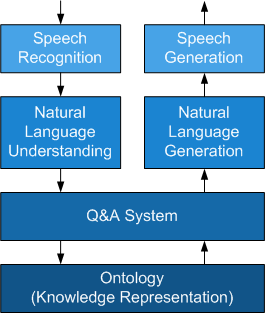
1. Introduction
In Natural Language Processing (NLP), a computer must represent the meaning of language in a structured form so that it can understand and process it.
Representation refers to how information from natural language is stored inside a computer system.
Understanding refers to the process by which a system interprets the meaning of a sentence or text.
Thus, representation and understanding are essential for building systems that can interpret human language.
2. Representation in NLP
Definition
Representation is the process of converting natural language sentences into structured formats that computers can process.
These representations help the system to:
Store knowledge
Interpret meaning
Perform reasoning
Example
Sentence:
“Ram eats an apple.”
Possible representation:
Subject → Ram
Action → eats
Object → apple
This structured representation helps the computer understand the sentence meaning.
3. Types of Language Representations
1. Logical Representation
Logical representation uses formal logic expressions to represent sentence meaning.
Example:
Sentence:
“Ram loves Sita.”
Logical form:
Love (Ram, Sita)
This representation helps the system perform logical reasoning.
2. Semantic Networks
A semantic network represents knowledge using nodes and relationships.
Example:
Ram → is a → Person
Ram → eats → Apple
It represents the meaning of words through connections between concepts.
3. Frames
Frames are data structures used to represent stereotypical situations.
Example:
Frame: Restaurant
Attributes:
Customer
Waiter
Menu
Food
Payment
Frames help systems understand common situations in real life.
4. Conceptual Dependency
Conceptual dependency represents meaning using primitive actions and relationships.
Example:
Sentence:
“Ram gave a book to Sita.”
Representation:
Actor → Ram
Object → Book
Recipient → Sita
Action → Transfer
This method focuses on the conceptual meaning of actions.
4. Understanding in NLP
Understanding means interpreting the actual meaning of sentences.
It involves several steps:
Lexical analysis – identify words
Syntactic analysis – check grammar structure
Semantic analysis – determine meaning
Pragmatic analysis – understand context
Example:
Sentence:
“The boy opened the door.”
Understanding involves identifying:
Agent → boy
Action → opened
Object → door
5. Importance of Representation and Understanding
These concepts are important because they allow computers to:
Interpret human language
Answer questions
Translate languages
Perform reasoning
Communicate with humans
Applications include:
Chatbots
Machine translation
Question-answering systems
Voice assistants
6. Conclusion
Representation and understanding are fundamental concepts in NLP. Representation converts natural language into structured forms that computers can process, while understanding interprets the meaning of language using linguistic and contextual analysis. Together, they enable machines to interact effectively with human language.
✅ Short Exam Answer (5 Marks)
Representation in NLP refers to converting natural language sentences into structured forms such as logical expressions, semantic networks, frames, or conceptual dependencies. These representations allow computers to store and process language information. Understanding refers to the process of interpreting the meaning of sentences using lexical, syntactic, semantic, and pragmatic analysis. Representation and understanding together enable machines to interpret human language effectively.
If you want, I can also explain the next Unit-1 topics (important for exams):
Organization of Natural Language Understanding Systems
Linguistic Background: Outline of English Syntax.
Organization of Natural Language Understanding Systems (NLU)
1. Introduction
A Natural Language Understanding (NLU) system is designed to enable computers to interpret and understand human language.
The organization of an NLU system refers to the structure or arrangement of different components that work together to process and understand natural language.
These components process language step by step, converting raw text into meaningful information.
2. Basic Structure of an NLU System
A typical Natural Language Understanding system consists of the following main components:
Input Processing
Lexical Analysis
Syntactic Analysis
Semantic Analysis
Discourse Integration
Pragmatic Analysis
Knowledge Representation
Each component performs a specific function in understanding language.
3. Components of NLU Systems
1. Input Processing
The system receives text or speech input from the user.
Example input:
“What is the weather today?”
Speech input may first be converted to text using speech recognition.
2. Lexical Analysis
Lexical analysis breaks the input sentence into words or tokens.
Example:
Sentence:
“The boy is playing.”
Tokens:
The
boy
is
playing
It also identifies part-of-speech (POS) like noun, verb, adjective.
3. Syntactic Analysis (Parsing)
Syntactic analysis determines the grammatical structure of a sentence.
Example:
Sentence:
“The boy plays cricket.”
Structure:
Subject → boy
Verb → plays
Object → cricket
Parsing checks whether the sentence follows grammar rules.
4. Semantic Analysis
Semantic analysis determines the meaning of words and sentences.
Example:
Sentence:
“The bank is closed.”
Meaning depends on context:
Financial bank
River bank
Semantic analysis selects the correct meaning.
5. Discourse Integration
Discourse integration considers relationships between multiple sentences.
Example:
Sentence 1:
Ram bought a car.
Sentence 2:
He drives it every day.
The system must understand that “He” refers to Ram.
6. Pragmatic Analysis
Pragmatic analysis interprets language based on context and real-world knowledge.
Example:
Sentence:
“Can you open the window?”
Literal meaning → question about ability
Actual meaning → request to open the window
7. Knowledge Representation
Finally, the system stores the interpreted meaning in a structured format.
Example representation:
Action → open
Object → window
Agent → user
This structured knowledge allows the system to perform reasoning and respond correctly.
4. Flow of Natural Language Understanding
Typical NLU processing flow:
Input Sentence
↓
Lexical Analysis
↓
Syntactic Analysis
↓
Semantic Analysis
↓
Discourse Processing
↓
Pragmatic Interpretation
↓
Knowledge Representation
5. Importance of NLU System Organization
The organized structure helps systems:
Understand human language accurately
Process large amounts of text efficiently
Support AI applications
Applications include:
Chatbots
Question answering systems
Machine translation
Voice assistants
Short Exam Answer (5 Marks)
The organization of a Natural Language Understanding system refers to the structure of components that process and interpret human language. The major components include input processing, lexical analysis, syntactic analysis, semantic analysis, discourse integration, pragmatic analysis, and knowledge representation. These components work together to convert natural language input into meaningful information that computers can understand and process.
✅ If you want, I can also explain the last topic of Unit-1:
“Linguistic Background: An Outline of English Syntax”
This is very important in NLP exams and usually asked as a 10-mark question.
Linguistic Background: An Outline of English Syntax
1. Introduction
Syntax is the branch of linguistics that studies the structure and arrangement of words in a sentence.
In Natural Language Processing (NLP), syntax helps computers understand how words combine to form grammatically correct sentences.
English syntax mainly focuses on:
Sentence structure
Word order
Phrase structure
Grammatical rules
English generally follows the Subject–Verb–Object (SVO) order.
Example:
Ram eats an apple.
Subject → Ram
Verb → eats
Object → apple
2. Parts of Speech (POS)
English syntax is based on different parts of speech, which classify words according to their grammatical function.
Main POS categories:
| Part of Speech | Example |
|---|---|
| Noun | boy, car, teacher |
| Verb | run, eat, read |
| Adjective | big, small, happy |
| Adverb | quickly, slowly |
| Pronoun | he, she, they |
| Preposition | in, on, under |
| Conjunction | and, but |
| Determiner | a, an, the |
Example sentence:
The smart boy runs quickly.
The → determiner
smart → adjective
boy → noun
runs → verb
quickly → adverb
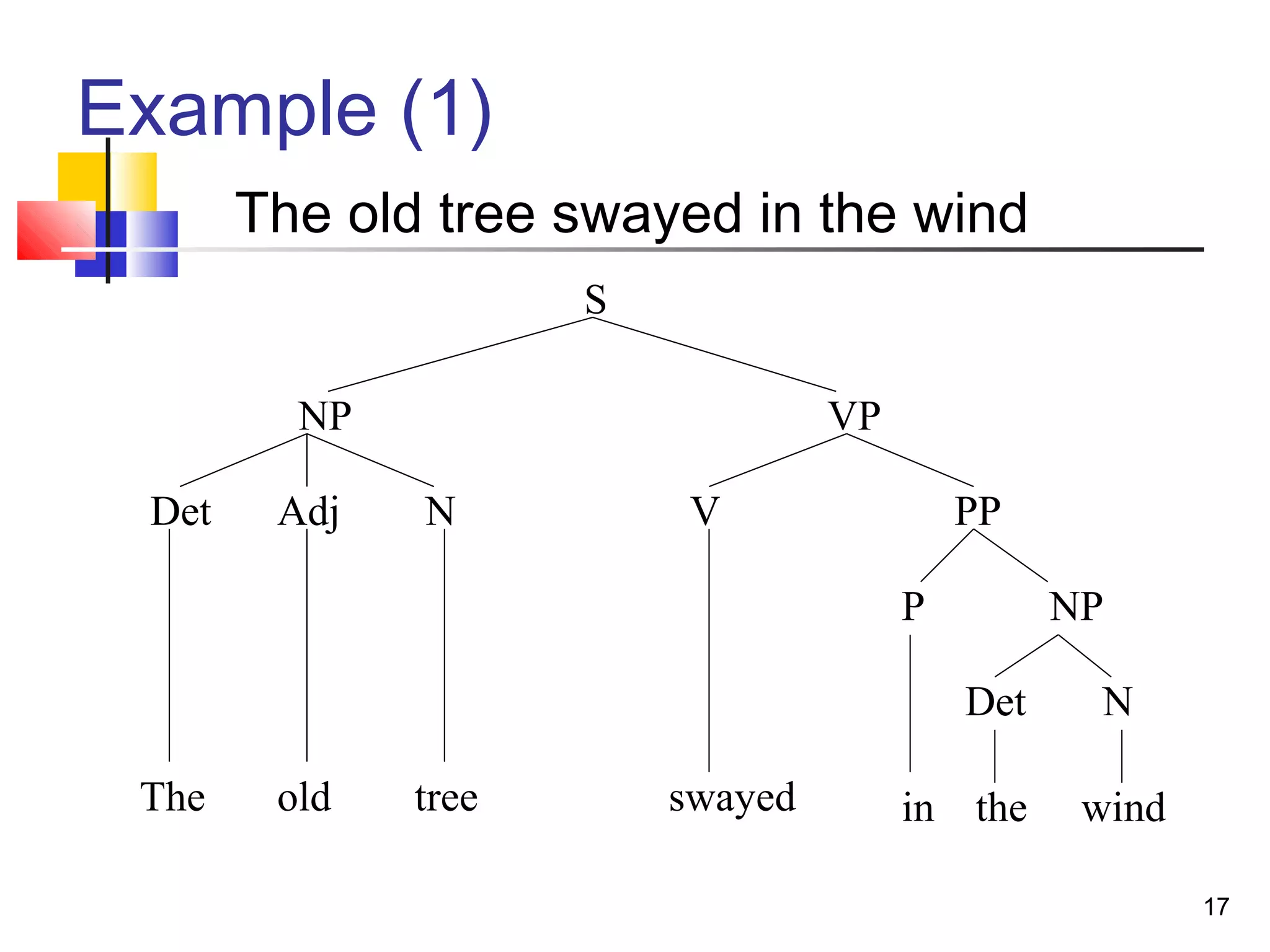
3. Phrase Structure
Sentences are made of phrases, which are groups of words functioning together.
Common phrase types:
1. Noun Phrase (NP)
A phrase that contains a noun and its modifiers.
Example:
The tall boy
Structure:
Determiner + Adjective + Noun
2. Verb Phrase (VP)
A phrase containing a verb and its objects.
Example:
is reading a book
Structure:
Verb + Object
3. Prepositional Phrase (PP)
A phrase beginning with a preposition.
Example:
in the room
Structure:
Preposition + Noun Phrase
4. Sentence Structure
A typical English sentence structure is:
Sentence → Noun Phrase + Verb Phrase
Example:
Sentence:
The boy plays cricket
NP → The boy
VP → plays cricket
5. Phrase Structure Grammar
In syntax, sentences are represented using phrase structure rules.
Examples of rules:
S → NP + VP
NP → Det + N
VP → V + NP
Example:
Sentence:
The boy eats an apple
S
→ NP + VP
NP
→ Det + N
→ The boy
VP
→ V + NP
→ eats an apple
6. Importance of English Syntax in NLP
Understanding English syntax helps NLP systems:
Analyze sentence structure
Perform syntactic parsing
Identify relationships between words
Improve machine translation
Support question answering systems
Example application:
Grammar checking tools
Chatbots
Text analysis systems
7. Example Analysis
Sentence:
The girl reads a book
Structure:
S → NP + VP
NP → The girl
VP → reads a book
This structure helps the system identify:
Subject → girl
Action → reads
Object → book
Short Exam Answer (5 Marks)
English syntax refers to the study of sentence structure and the rules governing how words combine to form grammatically correct sentences. English generally follows the Subject–Verb–Object order. Sentences are composed of phrases such as noun phrases, verb phrases, and prepositional phrases. Phrase structure rules like S → NP + VP help represent sentence structures. Understanding syntax is important in Natural Language Processing for parsing sentences and analyzing grammatical relationships.
✅ You have now completed all Unit-1 topics:
Introduction to Natural Language
Study of Language
Applications of NLP
Evaluating Language Understanding Systems
Different Levels of Language Analysis
Representations and Understanding
Organization of NLU Systems
Outline of English Syntax
If you want, I can also give Unit-1 important exam questions (very useful for JNTUK / M.Tech exams).


No comments:
Post a Comment