NLP
UNIT-2
Grammars and Parsing – Top-Down and Bottom-Up Parsers
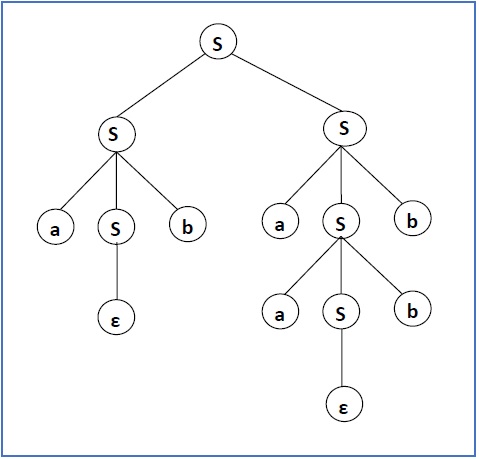
1. Grammars in Natural Language Processing
Definition
A grammar is a set of rules that describe how words combine to form valid sentences in a language.
In Natural Language Processing (NLP), grammars are used to:
Check sentence structure
Analyze syntax
Build parse trees
A commonly used grammar is Context Free Grammar (CFG).
Example Grammar Rules
S → NP + VP
NP → Det + N
VP → V + NP
Example sentence:
The boy eats an apple
Parse using grammar rules:
S
→ NP + VP
NP
→ The boy
VP
→ eats an apple
These rules help the system understand sentence structure.
2. Parsing in NLP
Definition
Parsing is the process of analyzing a sentence according to grammar rules to determine its syntactic structure.
The result of parsing is a parse tree.
Example:
Sentence:
The boy reads a book
Parsing identifies:
Subject → boy
Verb → reads
Object → book
3. Types of Parsers
There are two main parsing approaches:
Top-Down Parsing
Bottom-Up Parsing
4. Top-Down Parser
Definition
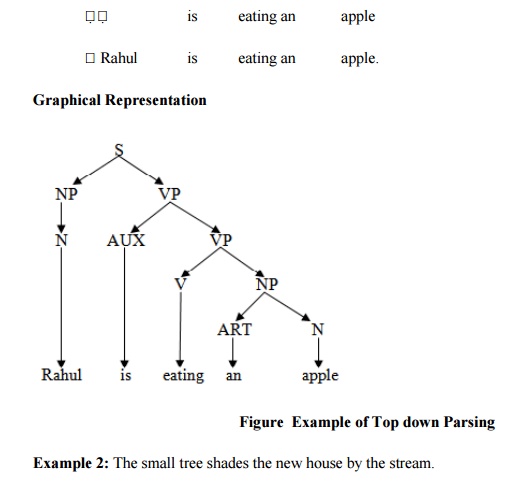
A Top-Down Parser starts from the start symbol (S) and tries to generate the input sentence using grammar rules.
It expands the parse tree from root to leaves.
Process
Start with:
S
Apply grammar rules step by step until the sentence is formed.
Example:
Sentence:
The boy eats an apple
Steps:
S
→ NP + VP
NP
→ Det + N
→ The boy
VP
→ V + NP
→ eats an apple
Advantages
Easy to understand
Simple implementation
Disadvantages
Cannot handle left-recursive grammars
May generate unnecessary trees
5. Bottom-Up Parser
Definition
A Bottom-Up Parser starts with the input words and gradually builds the parse tree towards the start symbol (S).
It constructs the tree from leaves to root.
Process
Sentence:
The boy eats an apple
Steps:
Identify words
Combine them into phrases
Build larger structures
Example:
The + boy → NP
eats + apple → VP
NP + VP → S
6. Shift-Reduce Parsing (Bottom-Up Method)
One common bottom-up method is Shift-Reduce Parsing.
Steps:
Shift – read input words
Reduce – apply grammar rules to combine words
Example:
Sentence:
The boy runs
Shift → The
Shift → boy
Reduce → NP
Shift → runs
Reduce → VP
NP + VP → S
7. Differences Between Top-Down and Bottom-Up Parsing
| Feature | Top-Down Parser | Bottom-Up Parser |
|---|---|---|
| Parsing Direction | Root → Leaves | Leaves → Root |
| Start Point | Start symbol (S) | Input sentence |
| Tree Construction | From top | From bottom |
| Efficiency | May generate unnecessary trees | More efficient |
| Example Method | Recursive descent | Shift-reduce |
8. Importance of Parsing in NLP
Parsing is important for:
Understanding sentence structure
Machine translation
Grammar checking
Question answering systems
Chatbots
Short Exam Answer (10 Marks)
Grammars define the rules that describe how words combine to form valid sentences in a language. In NLP, grammars such as Context Free Grammar are used to analyze sentence structure. Parsing is the process of analyzing a sentence using grammar rules to produce a parse tree. Two main parsing approaches are Top-Down and Bottom-Up parsing. Top-Down parsing starts from the start symbol and generates the sentence using grammar rules, while Bottom-Up parsing starts from input words and builds the parse tree towards the start symbol. Both methods help NLP systems understand syntactic structure.
✅ If you want, I can also explain the next Unit-2 topics (very important for exams):
Transition Network Grammars
Feature Systems and Augmented Grammars
Morphological Analysis and the Lexicon
Augmented Transition Networks (ATN).
Transition Network Grammars (TNG)
1. Introduction
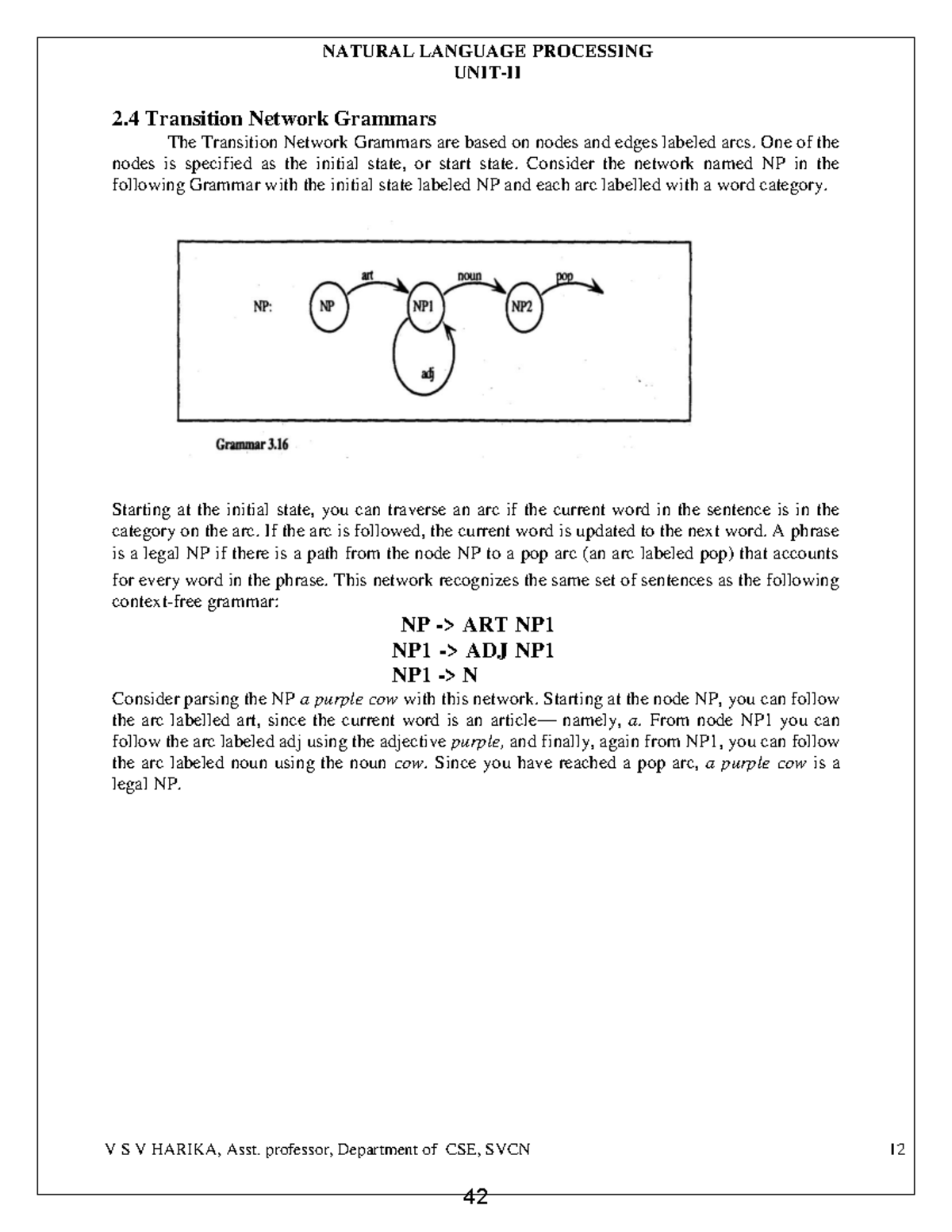
Transition Network Grammar (TNG) is a grammar representation used in Natural Language Processing (NLP) for parsing sentences.
It represents grammar using a network of states and transitions.
In this method:
Nodes (states) represent positions in parsing.
Arcs (transitions) represent grammatical rules.
The parser moves from one state to another while reading words in a sentence.
2. Basic Idea of Transition Network Grammar
A Transition Network is similar to a finite state machine.
It consists of:
States (nodes)
Transitions (arcs)
Start state
Final state
The parser reads words and moves through the network until it reaches the final state.
If it reaches the final state successfully, the sentence is considered grammatically correct.
3. Example of Transition Network
Example sentence:
The boy reads a book
Grammar structure:
Sentence → Noun Phrase + Verb Phrase
Step-by-step transition
Start State
↓
Noun Phrase (NP)
↓
Verb Phrase (VP)
↓
End State
Example transitions:
Start → NP
NP → VP
VP → End
4. Components of Transition Network Grammar
1. Nodes (States)
States represent positions in sentence parsing.
Example:
Start state
NP state
VP state
Final state
2. Arcs (Transitions)
Arcs represent grammar rules.
Example:
NP → Det + N
Example words:
Det → The
N → boy
3. Labels
Transitions are labeled with grammar symbols or words.
Example:
Det → the
N → boy
5. Types of Transition Networks
1. Simple Transition Networks
These represent grammar rules using basic state transitions.
Example:
Sentence → NP + VP
2. Recursive Transition Networks (RTN)
These networks allow recursive structures.
Example:
Sentence → NP + VP
VP → V + NP
Recursive networks can handle complex sentences.
6. Example Parsing
Sentence:
The boy eats apples
Transition steps:
Start
↓
Det → The
↓
N → boy
↓
V → eats
↓
N → apples
↓
End
The parser moves through the network and reaches the final state.
7. Advantages of Transition Network Grammar
Easy representation of grammar rules
Efficient sentence parsing
Useful for syntactic analysis
Can represent recursive structures
8. Limitations
Difficult to represent very complex grammar rules
May require large networks for large languages
9. Applications in NLP
Transition Network Grammars are used in:
Sentence parsing
Syntax analysis
Natural language understanding systems
Early NLP systems
Short Exam Answer (5–10 Marks)
Transition Network Grammar is a method used in Natural Language Processing to represent grammar using a network of states and transitions. It consists of nodes representing states and arcs representing grammatical rules. A parser moves through the network while reading words in a sentence until it reaches the final state. If the final state is reached successfully, the sentence is considered grammatically correct. Transition Network Grammars are useful for syntactic analysis and sentence parsing.
✅ If you want, I can also explain the next Unit-2 topics which are very frequently asked in NLP exams:
Feature Systems and Augmented Grammars
Morphological Analysis and the Lexicon
Parsing with Features
Augmented Transition Networks (ATN).
Feature Systems and Augmented Grammars


1. Introduction
In Natural Language Processing (NLP), simple grammar rules like Context Free Grammar (CFG) are sometimes not enough to represent all language constraints.
To handle additional information such as:
Number (singular/plural)
Gender
Person
Tense
we use Feature Systems and Augmented Grammars.
These methods add extra information called features to grammar rules so that the parser can understand language more accurately.
2. Feature Systems
Definition
A Feature System is a method of representing linguistic information using features and their values.
Features describe grammatical properties of words.
Example features:
| Feature | Possible Values |
|---|---|
| Number | singular, plural |
| Gender | masculine, feminine |
| Person | first, second, third |
| Tense | past, present, future |
Example
Sentence:
The boy runs
Features:
boy
Noun
Number = singular
runs
Verb
Number = singular
Tense = present
The feature system checks agreement between words.
3. Feature Structures
Features are often represented using feature structures.
Example representation:
Word: boy
Category = noun
Number = singular
Gender = masculine
Word: boys
Category = noun
Number = plural
This structure helps the system understand grammatical relationships.
4. Augmented Grammars
Definition
Augmented Grammars are grammars that include additional feature information along with grammar rules.
They extend simple grammar rules to include feature constraints.
Example CFG rule:
S → NP + VP
Augmented grammar rule:
S → NP (number = X) + VP (number = X)
This ensures subject–verb agreement.
5. Example of Augmented Grammar
Sentence:
✔ The boy runs
NP → singular
VP → singular
Sentence is correct.
Sentence:
✘ The boy run
NP → singular
VP → plural
Grammar rule fails because number agreement is incorrect.
Augmented grammars help detect such errors.
6. Attribute Value Matrix (AVM)
Features are often represented using Attribute Value Matrices.
Example:
Word: runs
Category: Verb
Tense: Present
Number: Singular
Person: Third
This structured representation helps in parsing and grammar checking.
7. Advantages of Feature Systems and Augmented Grammars
Represent detailed linguistic information
Ensure agreement between words
Improve syntactic analysis
Help in accurate sentence parsing
8. Applications in NLP
Used in:
Grammar checking systems
Natural language parsers
Machine translation
Speech processing systems
Short Exam Answer (5–10 Marks)
Feature systems represent linguistic information using features such as number, gender, person, and tense. These features help describe grammatical properties of words. Augmented grammars extend traditional grammar rules by adding feature information to ensure grammatical constraints such as subject–verb agreement. For example, a rule may require that the noun phrase and verb phrase have the same number feature. Feature systems and augmented grammars improve syntactic analysis and allow NLP systems to handle complex language structures more accurately.
✅ If you want, I can explain the next very important Unit-2 topics (often asked in exams):
Morphological Analysis and the Lexicon
Parsing with Features
Augmented Transition Networks (ATN).
Morphological Analysis and the Lexicon
1. Introduction
In Natural Language Processing (NLP), understanding words is an important step in language processing. Two important concepts used for this purpose are:
Morphological Analysis
Lexicon
Morphological analysis studies the internal structure of words, while the lexicon is a dictionary that stores information about words.
2. Morphological Analysis
Definition
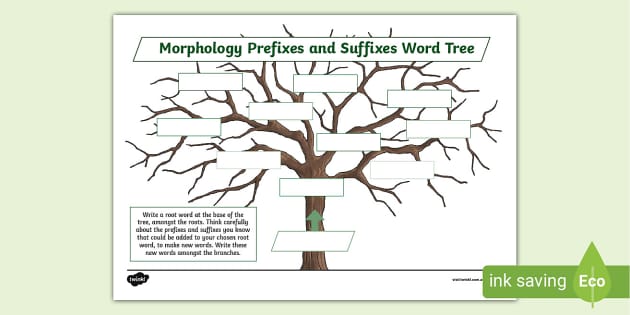
Morphological analysis is the process of analyzing a word into its basic components called morphemes.
A morpheme is the smallest unit of meaning in a language.
Types of Morphemes
1. Root Morpheme
The main part of the word that carries the basic meaning.
Example:
play, happy, teach
2. Prefix
A morpheme added at the beginning of a word.
Examples:
un + happy → unhappy
re + write → rewrite
3. Suffix
A morpheme added at the end of a word.
Examples:
play + er → player
happy + ness → happiness
Example of Morphological Analysis
Word:
Unhappiness
Breakdown:
un + happy + ness
Meaning:
un → not
happy → root word
ness → state or condition
Importance in NLP
Morphological analysis helps:
Identify root words
Understand word variations
Process different word forms
Example:
running → run
played → play
3. Types of Morphological Processes
1. Inflection
Inflection modifies a word to express tense, number, or gender without changing its meaning.
Examples:
run → runs
book → books
play → played
2. Derivation
Derivation creates new words with new meanings.
Examples:
teach → teacher
happy → happiness
4. The Lexicon
Definition
A lexicon is a dictionary of words used in NLP systems.
It stores detailed information about each word.
This information may include:
Word meaning
Part of speech
Morphological structure
Pronunciation
Example Lexicon Entry
Word: runs
Information stored:
Root → run
Part of speech → verb
Tense → present
Number → singular
5. Role of Lexicon in NLP
The lexicon helps NLP systems:
Identify words in sentences
Determine part of speech
Understand word meanings
Perform morphological analysis
Example:
Sentence:
The boy runs fast
Lexicon helps identify:
boy → noun
runs → verb
fast → adverb
6. Relationship Between Morphology and Lexicon
Morphological analysis works together with the lexicon.
Process:
Input word is read
Lexicon checks whether the word exists
Morphological analyzer breaks the word into morphemes
Root word and grammatical information are identified
7. Applications in NLP
Morphological analysis and lexicons are used in:
Spell checking
Machine translation
Information retrieval
Speech recognition
Text processing
Short Exam Answer (5–10 Marks)
Morphological analysis is the process of analyzing words into their smallest meaningful units called morphemes. It helps identify prefixes, suffixes, and root words. Morphological processes include inflection and derivation. The lexicon is a dictionary used in NLP systems that stores information about words such as their meanings, part of speech, and grammatical properties. Morphological analysis and the lexicon together help NLP systems understand and process words effectively.
✅ If you want, I can explain the next important Unit-2 topics:
Parsing with Features
Augmented Transition Networks (ATN)
These are very commonly asked 10-mark questions in NLP exams.
Parsing with Features
1. Introduction
Parsing with Features is a method used in Natural Language Processing (NLP) to analyze sentences using grammar rules that include linguistic features.
Simple grammar rules sometimes cannot capture all grammatical constraints. Therefore, features such as number, gender, person, and tense are added to grammar rules to improve parsing accuracy.
These features help the parser ensure agreement between words in a sentence.
2. What are Features?
Features are properties that describe grammatical information about words.
Common features include:
| Feature | Possible Values |
|---|---|
| Number | singular, plural |
| Gender | masculine, feminine |
| Person | first, second, third |
| Tense | past, present, future |
| Case | subject, object |
These features help NLP systems interpret language correctly.
3. Feature-Based Grammar
In feature-based grammar, grammar rules are extended by attaching feature information.
Example simple rule:
S → NP + VP
Feature-based rule:
S → NP (number = X) + VP (number = X)
This rule ensures subject–verb agreement.
4. Example of Parsing with Features
Sentence:
✔ The boy runs
Features:
NP → boy
Number = singular
VP → runs
Number = singular
The parser checks whether the features match.
Since both are singular, the sentence is grammatically correct.
Sentence:
✘ The boy run
NP → singular
VP → plural
Features do not match, so the parser rejects the sentence.
5. Feature Structures
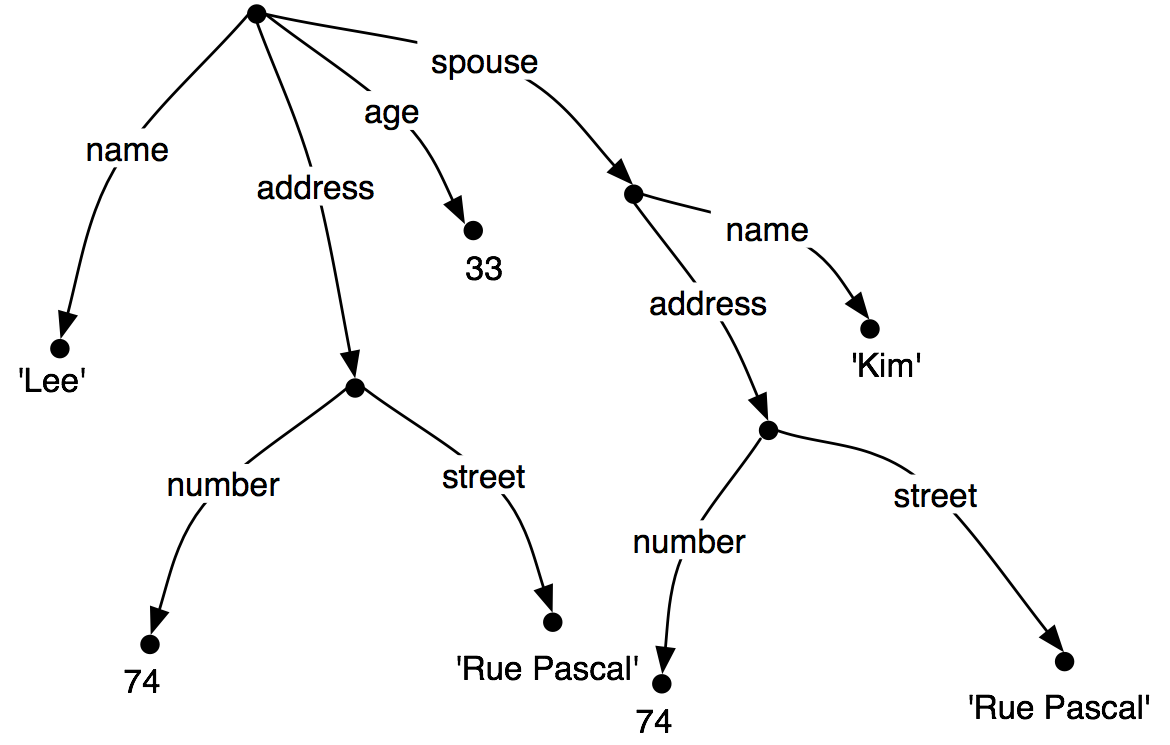
Features are usually represented using feature structures.
Example:
Word: runs
Category → Verb
Number → Singular
Tense → Present
Person → Third
This structure helps the parser analyze grammatical relationships.
6. Feature Unification
Parsing with features often uses a process called unification.
Definition
Unification is the process of combining feature structures and checking whether their values are compatible.
Example:
NP (number = singular)
VP (number = singular)
Unification succeeds because the values match.
7. Advantages of Parsing with Features
Handles complex grammar constraints
Ensures agreement between sentence elements
Improves parsing accuracy
Allows more detailed language representation
8. Applications in NLP
Parsing with features is used in:
Grammar checking systems
Natural language parsers
Machine translation
Question answering systems
Short Exam Answer (5–10 Marks)
Parsing with features is a method used in Natural Language Processing where grammar rules are extended with linguistic features such as number, gender, person, and tense. These features help ensure grammatical constraints like subject–verb agreement during parsing. Feature structures represent grammatical properties of words, and unification is used to combine and verify feature compatibility. Parsing with features improves syntactic analysis and enables NLP systems to handle complex language structures effectively.
✅ If you want, I can explain the last topic of Unit-2:
Augmented Transition Networks (ATN)
This is one of the most frequently asked 10-mark questions in NLP exams.
Augmented Transition Networks (ATN)
1. Introduction
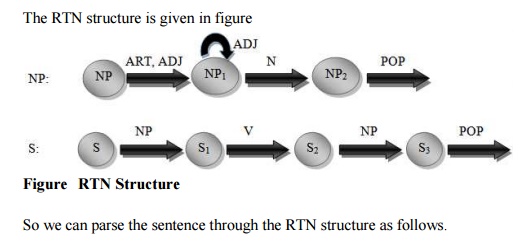
Augmented Transition Networks (ATN) are an advanced form of Transition Network Grammars used in Natural Language Processing (NLP).
ATN extends Recursive Transition Networks (RTN) by adding:
Registers (memory storage)
Tests (conditions)
Actions (operations)
These additional mechanisms allow ATNs to handle complex language structures more effectively.
ATNs are widely used in syntactic parsing and early natural language understanding systems.
2. Basic Idea of ATN
An Augmented Transition Network represents grammar as a network of states connected by transitions.
While parsing a sentence:
The parser starts at a start state
Moves through the network by reading words
Executes actions and tests
Reaches a final state if the sentence is valid
3. Components of ATN
1. States
States represent positions in the parsing process.
Examples:
Start state
Intermediate state
Final state
2. Arcs (Transitions)
Arcs connect states and represent grammar rules or conditions.
Example:
NP → Det + N
The parser moves from one state to another when the condition is satisfied.
3. Registers
Registers are memory locations used to store information during parsing.
They store:
Subject information
Verb information
Sentence structure
Example:
Register may store:
Subject = boy
Verb = runs
4. Tests
Tests are conditions that must be satisfied before a transition is taken.
Example:
Check whether:
Number(NP) = Number(VP)
This ensures subject–verb agreement.
5. Actions
Actions perform operations such as:
Storing information in registers
Building parse trees
Recording grammatical relationships
4. Example of ATN Parsing
Sentence:
The boy reads a book
Parsing steps:
Start State
↓
Det → The
↓
N → boy
↓
V → reads
↓
N → book
↓
Final State
During parsing, the system stores information such as:
Subject → boy
Verb → reads
Object → book
5. Advantages of ATN
Can handle complex sentence structures
Allows recursion in grammar rules
Uses memory (registers) to store information
Supports syntactic and semantic analysis
6. Limitations
ATN models can become very complex
Difficult to design for large grammars
Requires more computation
7. Applications in NLP
Augmented Transition Networks are used in:
Natural language parsing
Natural language understanding systems
Early AI language systems
Grammar checking
Short Exam Answer (5–10 Marks)
Augmented Transition Networks (ATN) are an extension of Recursive Transition Networks used in Natural Language Processing for syntactic parsing. ATNs represent grammar as a network of states connected by transitions. They include additional mechanisms such as registers, tests, and actions that allow the parser to store information and check conditions during parsing. These features enable ATNs to handle complex language structures effectively. ATNs are used in natural language understanding systems and sentence parsing.
✅ Now you have completed Unit-2 syllabus topics:
Grammars and Parsing
Top-Down and Bottom-Up Parsers
Transition Network Grammars
Feature Systems and Augmented Grammars
Morphological Analysis and Lexicon
Parsing with Features
Augmented Transition Networks
If you want, I can also give 4 very important exam questions from Unit-2 (based on previous NLP exam papers).